Gold and Goblins: Mining Games
- 4.0
- Rating
- 50.00M
- Installs
- Free
- Price
 Analysis by App-foxy
I started Gold and Goblins: Mining Games expecting a simple tapper, and that is exactly where its appeal begins. I send goblin diggers into a mine, watch them break through obstacles, collect resources, and use the results to improve the operation. The action is uncomplicated, but the game is good at turning small decisions into a reason to check back a few minutes later.
This is a free simulation game from AppQuantum, designed for players who enjoy gradual progress rather than fast reflex challenges. Its central idea is easy to understand: combine and improve goblin miners, push deeper underground, and make the mining process more productive. The presentation is friendly enough for an Everyone audience, while the progression gives the loop enough structure to keep it from feeling like a single button repeated forever.
After spending time with it, I see the game as a good fit for short, relaxed sessions. It is especially comfortable when I want something I can open, make a few choices, collect a reward, and close without losing track of a complicated story. At the same time, its simplicity can become a limitation if you are looking for a deep management simulator or a game where every action requires careful skill.
You May Also Like

 Blood Strike: 2.5 Anniversary
Blood Strike’s Loadouts Turn Every Drop Into a Tactical Gamble
A close look at Blood Strike’s custom loadouts: how fast access to signature weapons reshapes its battle royale rhythm, rewards preparation, and narrows the gap between fights.

 Pandora - Music & Podcasts
Pandora’s Music Is Easy to Start, but Harder to Recover
Pandora’s strength is its low-effort path from a seed to a station. Its weak spot is how much confidence it asks you to place in connection, setup, and quiet recovery.

 8 Ball Pool
 Is Built on Rivalries, Rematches, and Routine
A close look at the rivalries, rematches, shared routines, and unanswered safety questions that turn a quick pool match into a persistent mobile community.

 Samsung Music
’s Quiet Strength Is Playing What You Already Own
Its reach comes less from spectacle than from dependable access to a personal library. That simplicity is both the app’s strongest retention engine and its ceiling.

 AccuWeather: Weather Radar
AccuWeather Review: A Quick, Clear Forecast for Everyday Decisions
For everyday plans, the best forecast is the one you can understand quickly. AccuWeather makes rain timing, radar, and local conditions easy to act on, with a few trade-offs.

 Hill Climb Racing
Why Hill Climb Racing Still Turns Crashes Into One More Run
A tiny car, a bumpy hill and one more upgrade: Hill Climb Racing keeps resurfacing because its simple chaos makes every near-miss feel personal.
More From Our News Desk



How the mining loop feels from the first action to the next session
I find that the most useful way to judge Gold and Goblins is to notice what happens between visits, not just how quickly the first miners start working. A short session can leave me with a practical next step, but the routine works best when I decide what I want to improve before spending rewards. That makes it easier to spot whether the game’s steady pace suits me or starts to feel like waiting.
Starting with one clear job
The first useful action is straightforward: get the goblin diggers working. The mine gives me an immediate visual goal, and the movement of the characters makes progress easy to read. I do not need to learn a long chain of menus before seeing something happen. That quick start matters because this kind of game depends on instant feedback; if the opening were slow, the whole concept would feel like waiting.
The merge element adds the first meaningful choice. Rather than treating every goblin as a permanent finished unit, I can combine diggers to create a stronger mining workforce. The decision is simple, but it gives the opening moments a little more purpose than merely tapping a screen. I am not only collecting characters; I am deciding when separate pieces are more useful as one improved piece.
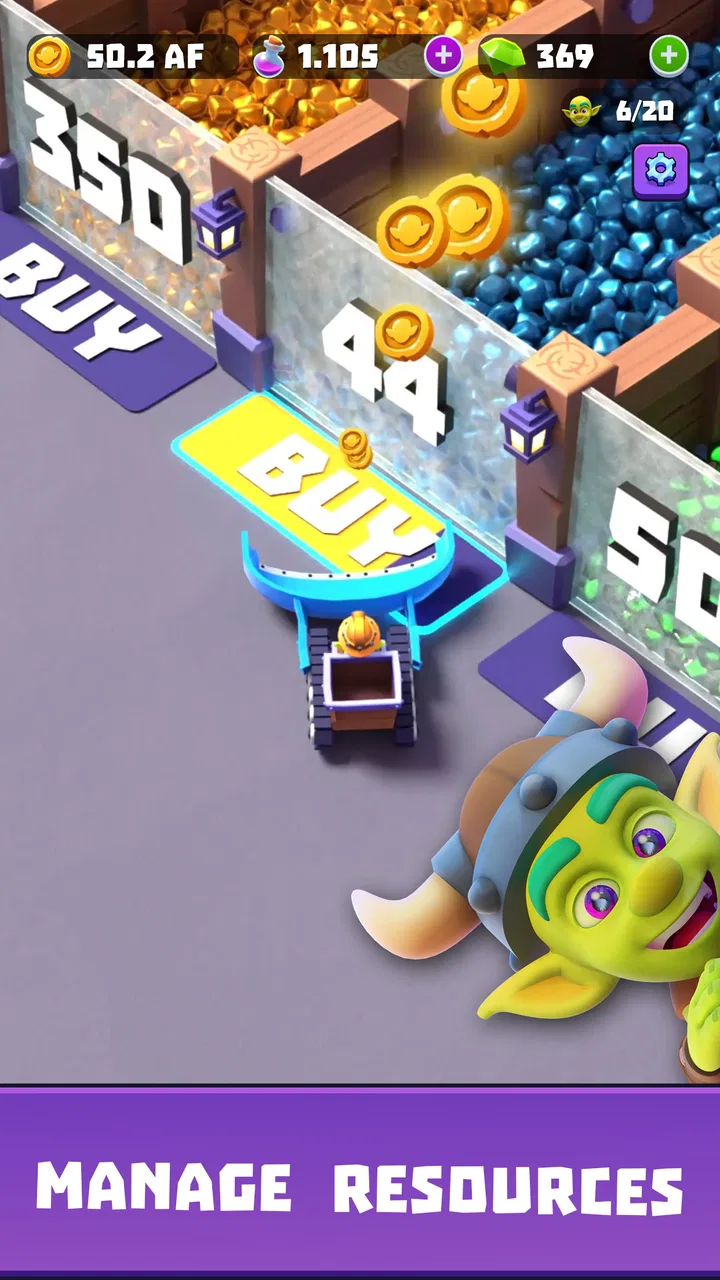
I like that this action has a visible consequence. Stronger miners make the mine feel more active, and the improvement is easy to understand without reading a technical explanation. The game communicates through movement, breaking, collecting, and unlocking progress. For a casual player, that is more welcoming than a system that hides every benefit behind statistics.
The trade-off is that the early interaction does not demand much precision. If you prefer games built around timing, aiming, or complex resource chains, the first action may seem too light. Gold and Goblins is not trying to test your reflexes. It is built around arranging progress and enjoying the result, which makes it better for relaxed play than for competitive concentration.
Why the feedback rhythm keeps me involved
The strongest part of the experience is the rhythm between action and response. A goblin works, the mine changes, a resource appears, and the next upgrade becomes easier to imagine. That sequence gives me a small reward often enough to maintain attention without requiring me to stay locked to the screen.
There is a pleasant difference between opening the game to do something and opening it only to claim something. Here, the mining activity itself provides motion and context. I can watch the work continue, make an improvement, and then see the improved setup produce another result. That creates a compact cycle of cause and effect: my choice changes the operation, and the operation gives me a reason to make another choice.
I found this rhythm useful in ordinary gaps during the day. If I have a short break while waiting for an appointment or taking a pause from work, I can check the mine, combine available diggers, spend progress on an upgrade, and leave. The game does not require me to remember a large quest log or reconstruct a complicated plan after a few hours away.
The feedback is also visual rather than purely numerical. Seeing miners move through the environment gives the rewards a physical feeling. I know that a stronger team is doing more than making a number rise; the mine appears more productive. That small presentation decision helps the simulation feel more alive than a menu-based idle game where progress is represented only by counters.
Still, the rhythm can become predictable. Once I understand the basic relationship between merging, mining, and upgrading, there are fewer surprises in the moment-to-moment play. The satisfaction comes from accumulation, not discovery. I would recommend it to someone who likes a familiar routine, but not to someone who needs constant new mechanics to stay interested.
What the rewards are really doing
The rewards serve two purposes. First, they show that the current setup is working. Second, they give me a reason to improve the next cycle. Gold and other mining gains are not exciting because of a single dramatic payout; they are satisfying because they shorten the distance to the next useful upgrade.
This is where the simulation label makes sense. I am not simply tapping for points with no context. I am building a more capable mining operation, and each improvement changes how I think about the next stretch of progress. A reward feels best when I can immediately connect it to a practical decision: strengthen the diggers, improve the operation, or save for a more meaningful step.
One tip I found helpful is to avoid spending every reward the instant it appears. When several improvements are available, I get more value from pausing for a moment and asking which one will affect the next few actions most directly. A small upgrade that helps the current mining bottleneck can be more satisfying than an attractive purchase that does not change the immediate rhythm.
That does not turn the game into a demanding strategy title, but it gives the loop a little more texture. The best decisions are not about calculating a complicated formula. They are about noticing where the operation is slowing down and using the available reward to restore momentum.
The merge mechanic creates another useful trade-off. Combining goblins can make the team stronger and easier to manage, but the pleasure of collecting separate units is different from the pleasure of creating a better one. I found myself weighing immediate organization against the desire to keep building. That tension is small, yet it prevents the board from feeling completely automatic.
Why another session begins after I close the game
The reset is not a harsh restart. It is the natural pause between mining cycles. I leave after improving the operation, then return with a clear expectation: check what has accumulated, make the next upgrade, and see how far the mine can go. The reason to begin another session is not a new story chapter; it is the promise that the previous decision has produced a better starting position.
This structure works well for people who enjoy incremental games but do not want to spend every session from the beginning. Progress carries the feeling of continuity. Even when I only have time for a brief visit, the game offers a small piece of the larger climb rather than demanding a complete play period.
The reset also protects the game from becoming exhausting. Because the main activity is repetitive by design, I would not want to play it continuously for a long stretch. Closing the app at the right moment makes the next return feel more appealing. I can treat it as a background hobby instead of a game that needs to occupy my full attention.
There is a downside to this approach. If you dislike waiting for gradual improvement or prefer a clear finish line, the repeating cycle may feel empty. The game’s satisfaction depends on accepting that progress is made through many modest steps. Players who want a campaign with a dramatic conclusion may find a traditional adventure game more rewarding.
Practical ways to enjoy the game without overplaying it
I would use Gold and Goblins in short check-in windows rather than treating it as a full evening game. A useful routine is to open it when I have a natural pause, inspect the current mine, merge only when the resulting improvement is worthwhile, and spend rewards on the upgrade that removes the most immediate slowdown. Then I close it before the repetition starts to feel like work.
Another good habit is to separate active decisions from passive progress. When I am paying attention, I can organize miners and decide how to spend gains. When I am busy, I can leave the game alone and return later. That makes it easier to fit into a daily routine without feeling that I am constantly missing something.
I also recommend judging the game by its loop rather than by the promise of endless advancement. If the sight of a mine becoming more productive is satisfying to you, the gradual structure can be calming. If you need every session to offer a new puzzle, the same structure will probably feel repetitive sooner.
The game is free to download, but it includes optional in-app purchases ranging from $1.99 to $119.99 per item. That range is important to keep in mind before playing. I would approach purchases as convenience choices, not as a requirement for understanding the game. Anyone who prefers a completely purchase-free experience should decide on a personal limit before getting invested in the progression.
Because the content rating is Everyone, the tone is accessible for a broad audience. That makes it easy to recommend in a family setting from a content perspective, although younger players may still need guidance around optional purchases. The simple controls also make it approachable for people who do not usually play simulation games.
Where it stands beside other idle and simulation games
Compared with a traditional city-building simulator, this game is much lighter. There are fewer layers to track, and the focus stays on miners, merging, digging, and upgrades. That simplicity is a strength when I want a clear activity without managing roads, populations, production chains, or a large map.
Compared with a pure clicker, it has more visual identity and a stronger sense of physical work. The goblins are not just symbols beside a counter; they give the mine a recognizable cast of workers. The merge action also gives me something to arrange, which makes the progress feel more hands-on than pressing the same button for every reward.
On the other hand, a deeper management game will offer more meaningful long-term planning. If you enjoy balancing several resources, responding to changing conditions, or building an efficient system with many dependencies, Gold and Goblins may seem narrow. Its advantage is ease, not complexity.
It also differs from action mining games because the player is not primarily controlling a character through hazards or precision challenges. The excitement comes from watching the operation improve. I would choose this one for a calm progression loop, while I would choose an action alternative when I wanted direct control and immediate risk.
Who should play it and who should skip it
I think it suits players who enjoy idle progression, friendly fantasy presentation, and short sessions with a visible payoff. It is a particularly good choice for someone who likes checking a game several times during the day, making one or two upgrades, and leaving with the feeling that the next visit will be stronger.
It is also a sensible starting point for newcomers to simulation games. The mining theme is easy to grasp, the merge mechanic is intuitive, and the upgrade cycle gives enough direction without overwhelming the player. You do not need to study a guide before beginning.
I would skip it if your main reason for playing is challenge. There is no need to master tight controls or solve demanding tactical situations in the core loop. I would also skip it if repetitive progress bothers you, because the appeal comes from repeating a familiar pattern with gradually better results.
Players who are sensitive to in-app purchase prompts should be cautious as well. The free entry is convenient, but the presence of purchases means the game is best enjoyed with a clear spending boundary. If you want a one-time purchase with no ongoing temptation, a paid simulation may be a better match.
Technical fit and long-term impression
The game was released on September 16, 2020, and the current version is 1.47.0. It supports devices running Android 7.0 or later, so it is available to many Android users with older compatible phones. That broad compatibility is useful for a casual game because it does not demand that I treat hardware upgrades as part of the experience.
Its scale is reflected in its audience: it has passed 50 million installs, with an average rating of 4.0 from around 487 thousand ratings and roughly 25 thousand written reviews. Those figures suggest a game with wide reach and a substantial group of players, while the rating also feels consistent with the experience I had: enjoyable and polished in its niche, but not universally compelling.
The developer, AppQuantum, has kept the concept focused on the mining loop rather than turning it into an overloaded simulation. That focus is one of the reasons the game is easy to recommend selectively. I can explain the appeal in one sentence to a friend: improve the goblins, make the mine more productive, collect the result, and return when I want another small step forward.
My main criticism is that the loop asks me to enjoy repetition more than variety. The first upgrades feel meaningful because I am learning the system, but later progress depends on whether the same cycle remains satisfying. I also think the game would be less suitable for someone who wants a strong narrative or a clearly defined ending. Its purpose is ongoing improvement, not a dramatic conclusion.
My verdict on the complete action-feedback-reward-reset loop
Gold and Goblins works because every part of its cycle is easy to follow. I start by organizing goblin diggers, receive immediate visual feedback as they work, earn resources that support the next improvement, and then close the game with a better operation waiting for me later. That chain is simple, but it is coherent.
The best reason to try it is the low-pressure feeling. I can make progress without committing to a long session, and I can return after a break without needing to relearn the game. The most important caution is equally clear: its charm depends on enjoying gradual repetition, and optional purchases mean I should play with a spending limit in mind.
For me, this is a pleasant casual simulation rather than a deep strategy experience. I would recommend it to a friend who wants a colorful mining game for spare moments, especially if that friend likes merging units and watching small upgrades add up. I would point a more demanding player toward a richer management simulator or an action-focused mining game instead.
Overall, the loop earns another session because the reset feels productive rather than empty. I close the mine knowing that the next visit will begin from a stronger position, and that is enough motivation to return. If you enjoy small, visible improvements more than dramatic challenges, this is a free game worth trying.
FAQs for Gold and Goblins: Mining Games
01What is the main objective of Gold and Goblins: Mining Games?
Gold and Goblins: Mining Games aims to blend idle and strategy gameplay. Players manage a team of goblins to dig through mines, collect gold, and discover hidden treasures. As you progress, you must upgrade your goblins and equipment to conquer more challenging levels and uncover rare artifacts.
02Is Gold and Goblins: Mining Games free to play?
Yes, the game is free to download and play on both Android and iOS platforms. However, it includes in-app purchases that offer various boosts, gems, and other resources to enhance your gameplay experience. These are optional and not necessary for progression.
03Can I play Gold and Goblins: Mining Games offline?
Gold and Goblins: Mining Games primarily requires an internet connection for features like leaderboards and cloud saves. However, the core gameplay can be enjoyed offline, allowing you to continue mining and upgrading goblins without connectivity.
04What are the system requirements for Gold and Goblins: Mining Games?
The game is designed to run smoothly on most modern Android and iOS devices. It typically requires Android 5.0 or later and iOS 10.0 or later. Ensure you have sufficient storage space and a reliable internet connection for the best experience.
05How does the game handle in-app purchases and player spending?
Gold and Goblins: Mining Games offers a variety of in-app purchases to enhance gameplay, such as gems and special packs. The game encourages responsible spending by providing parental controls and spending limits, ensuring players can enjoy the game without overspending.
Pros
- Engaging gameplay with resource management.
- Visually appealing graphics and design.
- Frequent updates with new content.
- Easy to learn
- hard to master mechanics.
- Offline play available for convenience.
Cons
- In-app purchases can be pricey.
- Energy system limits long sessions.
- Repetitive tasks might bore some players.
- Ads can interrupt gameplay.
- Requires a stable internet for updates.

Gold and Goblins: Mining Games
Gallery